Are you losing customers in the gaps between your departments? It’s time to stop guessing and start mapping the reality of your customer experience.
There is often a significant disconnect in business. Inside the conference room, leadership teams believe they are delivering a seamless, superior customer experience. Yet, on the outside, customers feel frustrated, misunderstood, or simply undervalued.
This gap—the "experience chasm"—is where churn happens.
It’s easy to look at sales figures and metrics, but those numbers only tell you what is happening, not why. To understand the "why," and to fix the leaks in your revenue bucket, you need to step outside your internal silos and walk a mile in your customer’s shoes.
You need Customer Journey Mapping.
Beyond the Sales Funnel
Many businesses mistake a sales funnel for a customer journey. A funnel is theoretical; it’s how you want people to behave as they move toward a purchase.
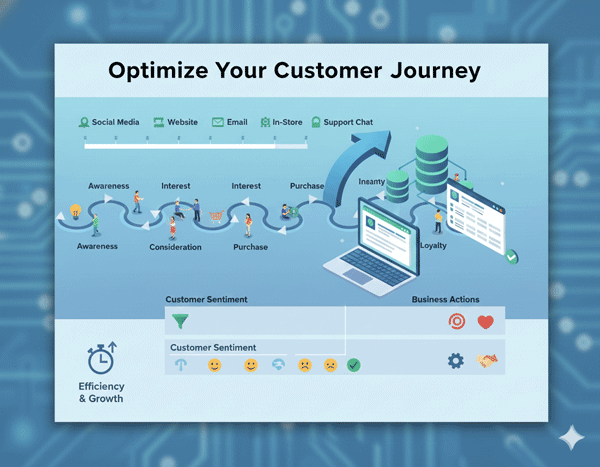
A Customer Journey Map is factual. It is a visual representation of every experience a customer has with your brand across every touchpoint—from the moment they realize they have a problem, through the purchase process, into onboarding, and hopefully, toward renewal and advocacy.
Crucially, a good journey map doesn't just track actions; it maps emotions. It identifies where the customer is excited, where they are confused, where they are anxious, and where they are delighted.
Why Journey Mapping is an Operational Necessity
Customer Journey Mapping is no longer a "nice-to-have" marketing exercise. In an era where experience is the primary differentiator, it is an operational necessity.
Here is why investing time in this process is critical for reducing churn and increasing loyalty.
1. It Exposes the "Invisible" Friction
Internally, your processes might look logical. Marketing hands off to Sales, Sales hands off to Onboarding, and Onboarding hands off to Support.
But to the customer, those handoffs often feel like dropped balls. Maybe they have to repeat their information three times to three different people. Maybe the tone of your marketing emails clashes with the tone of your support documentation.
These micro-frictions rarely show up in a quarterly report, but they accumulate. Eventually, the customer gets tired of the friction and leaves for a competitor who is easier to deal with. A journey map shines a spotlight on these hidden pain points.
2. It Unifies Internal Silos around the Customer
One of the biggest drivers of a disjointed customer experience is organizational silos. The web team doesn't talk to the call center; the product team doesn't read support tickets.
A Journey Map forces every department to look at the same reality. It provides a single source of truth that aligns everyone—from the C-suite to front-line staff—around the actual customer experience, rather than departmental KPIs.
3. It Shifts Focus from Acquisition to Retention
Companies often spend vastly more money acquiring new customers than keeping existing ones. Journey mapping helps rebalance this by identifying the "Moments of Truth" deep in the customer lifecycle—the critical junctures where loyalty is either cemented or lost forever. By optimizing the post-purchase phases, you turn passive users into active advocates.
How Better Touchpoints Reduce Churn and Build Loyalty
Once you have mapped the journey and identified the friction, the real work begins: optimizing the touchpoints.
A "touchpoint" is any interaction between your brand and the customer—a website visit, an invoice, a support chat, or even an error message.
When you use the insights from your journey map to improve these touchpoints, two things happen:
You Reduce Churn by Eliminating Effort:
Customer effort is the single biggest predictor of disloyalty. If it’s hard to return a product, hard to find an answer, or hard to upgrade a subscription, customers will churn. By smoothing out the rough edges identified in your map, you make it effortless to stay.
You Increase Loyalty by Exceeding Expectations:
Loyalty isn't just about preventing anger; it's about creating delight. The journey map highlights opportunities to be proactive. If you know customers always get confused at Week 3 of onboarding, a proactive, helpful outreach at Week 2, Day 6 turns a potential frustration into a moment of "wow, they get me."
The Challenge of Mapping from the Inside
If Customer Journey Mapping is so valuable, why doesn't everyone do it well?
Because it is incredibly difficult to read the label when you are sitting inside the jar. Internal teams are often too close to the product, too defensive of their own processes, or simply too busy putting out daily fires to step back and analyze the journey objectively.
This is where an external perspective becomes invaluable.
Introducing Our Customer Journey Analysis Package
At Tebault Technology Group, we specialize in bridging the gap between how you perceive your business and how your customers actually experience it.
Our Customer Journey Analysis package is designed to provide the objectivity, expertise, and actionable roadmap you need to reduce churn and foster deep loyalty.
We don't just deliver a pretty diagram. We provide:
-
Unbiased Research: We conduct interviews and analyze data to build a map based on reality, not internal assumptions.
-
Friction Point Identification: We pinpoint exactly where and why you are losing customers.
-
The "Moment of Truth" Blueprint: We identify the critical opportunities to turn satisfied customers into loyal advocates.
-
An Actionable Roadmap: You receive prioritized recommendations for fixing broken touchpoints, aligned with your business goals.
Stop guessing what your customers are feeling and start knowing.
If you are ready to see your business through your customer’s eyes and unlock the growth that comes with true customer-centricity, contact us today to learn more about our Customer Journey Analysis consulting, or schedule a time to meet using the calendar below.
Comments